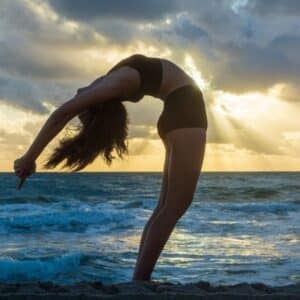
Sam Volmar

Finding Presence: A Conversation with Samantha Volmar
Longform interview series: Insights and practical advice for your life, health, and business.
Ever felt lost, only to discover your life's purpose on a living room carpet during a global pandemic? That's exactly what happened to Samantha Volmar—and what she found changed everything.
In this conversation, Sam reveals how a single 30-minute yoga session became a watershed moment that redirected her entire life.
Sam offers authentic, practical wisdom on building a sustainable wellness career without "the grind," setting boundaries that protect your energy, and teaching from a place of connection rather than performance.
In this interview, Sam shares how she:
- transformed a dark, disconnected period into a thriving yoga teaching career in less than a year
- uses breathwork as the essential (yet often neglected) bridge between mind and body
- helps students get out of their heads and into their bodies through intentional questioning and conscious movement
- turned rejection and criticism into redirection and deeper self-worth
- debunks the myth that you need to "grind" to succeed in the wellness industry
Sam also reveals her approach to daily affirmations that combat limiting beliefs, explains why adequate sleep is the most overlooked wellness practice, and shares why creating space for people to "move without judgment" is at the heart of everything she does.


Anthony Mandela (AM):
All right, Sam, let's get started! I thought I'd ask about your background and interests. Can you tell me a little more about some of the things you're most passionate about and how you got into this space?
Samantha Volmar (SV):
I found yoga back in 2020 during Covid. I'd just been furloughed from my job and felt very lost and disconnected; honestly, it was a dark time. I was in a toxic relationship, had no job, and just felt empty inside.
I remember the day exactly. I was in my living room, finally had space to myself for the first time in a while, and I found this random 30-day yoga program on Amazon Prime. I didn't even have a yoga mat. I sat down on my living room carpet for what was probably a 30-minute session, just finding my breath.
And it all came out. I had this big release…a huge shift. I'd always been chasing and achieving, constantly moving. Giving myself that time to slow down? I'd never really done that before.
I remember sitting there thinking, What am I doing with my life? It was like I'd just woken up, and opened the door to consciousness. It was an instant shift for me, a complete 180.
That was in August. That following November, I saw an online yoga training pop up on my Instagram algorithm. I messaged the facilitator, enrolled, and became certified shortly after.
AM:
Wow, so you jumped right in, then.
SV:
I jumped right in, yeah. I started teaching virtually soon after that, and then I moved to St. Pete that March. I found a yoga studio, sent my video in, and started teaching. I’ve been teaching ever since, and it's been almost five years now.
I love everything movement-related. I'm a big fan of breathwork and connecting with people. When I'm not doing yoga, I'm usually running, at the gym, or hanging out with my fiancé, my two cats, and my dog. I love being in the sun, getting a good tan. I'm also an earth sign, so I love green, trees, nature—all of it.
But I'm also a homebody. I'm like an extroverted introvert.
AM:
I understand that! I am as well. 😊
SV:
I love the comfort of my own home, but if you need me to show up, I can give you that splash of energy.
AM:
Tell me about the classes you like to teach. How do you structure them? How has your teaching style evolved, and what's your typical class setup?
SV:
My heart belongs to slow flows, a nice vinyasa flow. I start with breathwork in the beginning, then warm up the body: hips, shoulders. We get into warrior series, breath to movement, a little balancing in the middle, core at the end for some heat, and then cool down. I like taking my time in the beginning and adding heat in the middle.
AM:
If you had the opportunity to teach a workshop, what would you focus on and why?
SV:
The first thing that comes to mind is breathwork. The breath is so neglected. Obviously it's involuntary; we all do it without much thought. But when we really take it into our own hands and breathe intentionally, it shifts everything. The breath is the bridge between the mind and the body.
"We can do all the poses, but without the breath, it doesn't really matter."
AM:
It's amazing how often I hear this from instructors. The breath is, like you said, almost neglected by so many people. But for those who know yoga and understand its importance, it's often the first thing they mention. Why is that? Why is the simple task of breathing so important?
SV:
When we focus on the breath, the mind really has no option but to focus as well. You inhale, you exhale. You expand, you empty. As long as you can breathe, you can do yoga. I say that a lot, but it's true.
Nowadays, yoga has become so much about flexibility or looking a certain way. But at the end of the day, if we're not focusing on the breath, what's intentional about it? We can do all the poses, but without the breath, it doesn't really matter.
AM:
If you were teaching a workshop on this topic with a lot of newbies, how would you start, and how would you progress?
SV:
I'd have everyone settle, whether seated or on their backs. Just settling, landing, coming to their senses. Then, I'd have them bring awareness to their breath without changing it. Just notice the breath. Is it tight? All over the place? Hidden?
That simple shift of awareness can change everything. Sometimes I even ask the class, "Does anything change when you just bring awareness to your breath?" My teaching style, especially with breathwork, is about giving students the choice. I create the space, hold the space, and ask questions to let them decide.
Then we'll take three breaths as a community: inhale together, exhale together. After that, it becomes effortless.
AM:
How would you proceed from there once you've set that breathwork foundation?
SV:
I'd count with them. I do a lot of box breathing—inhale for four, hold for four, exhale for four. I'll have them put their hands on their hearts for connection, so they can feel their own physical body. I cue it constantly, whether it's a workshop or a flow, always bringing them back to the breath.
AM:
Do you incorporate movement with breathwork? And if so, how does that work?
SV:
After the integration, we'll come into a seat and do some breath to movement with the neck and shoulders (some shoulder rolls). Then we'll come into tabletop and do cat-cows, hips, calves, etc. Simple movements like that.
AM:
What got you interested in breathwork? Did you have a mentor, teacher, book, or training that sparked this journey?
SV:
I actually had a book called Just Breathe from Amazon. It went through the fundamentals of different types of breathing: whether to calm down, wake up, or practice in the morning, afternoon, or night.
AM:
Do you have any teachers or mentors you've looked up to in learning and teaching yoga?
SV:
Honestly, I'd say Molly Curls. She's incredible. She sees everyone, accepts everyone. When I was a mentee with her for three months, the biggest thing that stood out was how well she holds space for people. She helped me realize it's okay to feel all my emotions. Nowadays, we get scolded for feeling, whether angry, sad, whatever it may be. But it's okay. We're humans, not machines. Not every day is going to be light. Molly is amazing, and I'm grateful for that mentor-mentee relationship.
AM:
I'm curious to learn even more about your teaching style. For someone who's never taken one of your classes, is there anything unique about how you teach? Anything you'd want people to know?
SV:
I always start with an intention. I'll invite the student to set one, or if not, I'll offer one. That way, there's an anchor for the class.
I'd also say I'm super open to anyone who walks through the door. I see you for who you are, no matter where you're coming from, whether it's your first class or your hundredth with me. We're starting fresh. Every time a student walks through that door, I genuinely care. I want them to feel safe, to move without judgment. That's one of my biggest things: I try to be open so they have permission to let go as well.
AM:
I love how you phrase that—to move without judgment and create that welcoming space!
SV:
Because if you're moving with authenticity, you can't really move wrong.
AM:
Absolutely. What's something you've learned from your students over the years? Something surprising, or just something that's stuck with you?
SV:
In the beginning, I learned that not everyone will like your class, and that's actually positive. Not everyone will come back. Someone may come once, learn what they need, and move on. I've realized people can only learn so much from one teacher, and it's not a bad thing if you never see them again.
I see it like reading a book. You read it, get the knowledge, and it helps you. Sometimes we reread old books, sometimes we pass them along or recommend them. But the key is not to take it personally.
AM:
So well said. Do you feel like there are any myths surrounding yoga that you'd like to debunk?
SV:
One of the biggest is that you have to be flexible to do yoga. Like I said earlier, if you can breathe, you can do yoga.
Also, it's never too late to start. That's a big one—people think it's too late for them.
Another myth is that yoga classes have to be fast, all strong vinyasa. That's simply not true. There are many, many different styles.
AM:
100%. Some of the most challenging classes I've taken have been slow; holding poses, not moving fast at all.
SV:
Right. Most of the time when we're slower, we're in it for longer. I do like teaching faster classes and variety fitness like sculpt. They're fun. But when it comes to yoga, I always try to guide students through the sensations they feel in their body, the breath, and conscious movement.
AM:
I hesitate to use the term "wellness trend," but is there something in the wellness space that you feel is overlooked right now? Something you'd encourage people to research or look into?
SV:
Sleep. Adequate sleep is so, so important.
AM:
Tell me more.
SV:
I'm not perfect; I've had many sleepless nights. But balance is a big thing for me when it comes to rest. Sleep is always crucial. A good seven to eight hours a night can really change our productivity during the day, our energy, how we treat others. We have to fill our own cup before we can give.
AM:
It sounds simple, but it's not. A lot of people try to shortcut sleep first.
SV:
Exactly. Sleep should be the last thing to go, not the first.
AM:
Lack of sleep accumulates, too. Multiple nights of inadequate sleep builds up, and it takes time to get back to your baseline.
SV:
Yep, it's a domino effect.
AM:
Is there anything that's helped you personally get more consistent sleep? Something you'd like to share with others?
SV:
I find I sleep better when I'm not on my phone right before bed and when the TV's off. When we're trying to wind down with all these flashy, fast-scrolling devices, it's hard for our brains to relax or shut off.
Sometimes I like to consciously breathe before bed. I'll take 10 big breaths, and by the tenth breath, I already feel so much more relaxed. It sends my body a signal to slow down.
AM:
Is there anything you try to do each day—or on a consistent basis—to set the tone for your overall wellbeing? This could be a habit, a mindset, really anything important for your personal health.
SV:
Daily affirmations. I like to place sticky notes on mirrors to remind myself of my worth, power, and confidence.
AM:
With affirmations, do you think of phrases that come from you internally, or do you find inspiration from books or media? How do you set those intentions?
SV:
For me, the affirmations I choose combat my limiting beliefs. Things like "I am loved" and "I am enough." Those are the big ones for me.
"A limiting belief is something you grow up thinking about yourself through whatever lens you're using."
AM:
The term "limiting beliefs" is very interesting. Could you unpack that a bit more? What is a limiting belief? How might it surface, and how can you counteract it?
SV:
I believe a limiting belief is something you grow up thinking about yourself through whatever lens you're using. We all have our own realities. Anything you think you are or aren't—that's what you grow up believing about yourself. Beliefs that trigger you on a daily basis.
Whenever I get triggered, I ask myself why. There's a reason I feel that way, and it's usually something I've been through. Getting to the root of the belief is helpful. And it's also been helpful to tell myself the opposite.
Whether it's "I'm hateful" becoming "I love," whatever the opposite may be, I switch it. Then I'll look at myself in the mirror, put my hand over my heart, and tell myself I've got this. Our minds love to chatter, but the heart likes to whisper. It's important to make space to listen to what your heart might be whispering, then say the affirmation out loud in your own voice.
AM:
I love what you just said about the heart whispering.
SV:
Thanks. The mind loves to be loud, but the heart—the spirit—whispers. It's easy to cover up and not listen to your true desires.
AM:
That's profound. Your heart knows the answer. It may be deep down, but it knows. It's our job to listen and identify.
SV:
To search our heart and listen to the whisper. The more we slow down, the more we can, counterintuitively, speed up and accomplish. When we wake up in the morning, let's foster activities for a clear mind and not just jump right on our phones. What are we thinking about? How do we start and end each day? What comes to mind when we slow down? How do we feel after a good workout or yoga class?
AM:
Right. Maybe it's something simple like stepping outside and looking up.
SV:
Maybe you'll see a shooting star! Our creative mind comes out when we're relaxed and not consciously thinking about day-to-day tasks and responsibilities. I want to help people get out of their heads. Some people unfortunately spend their whole lives stuck in their heads, never tuning into their full power or knowing who they truly are or what they're capable of.
I just want to share that feeling, whether it's a minute during class or even just a few seconds, of shifting out of the head and getting into the body.
AM:
Do you have any tools you especially like for helping people get out of their heads?
SV:
I'll start with breathwork and then ask them how they're feeling. How do they feel today? What does their body need today? It may look different from yesterday. I might also ask more specific questions about why they make the choices they do. I try to ask a lot of questions.
AM:
My next question is a fun, quirky one. Do you have any unusual habits or unique things that you love?
SV:
Do you drink kombucha?
AM:
I love kombucha!
SV:
So, I'll open a kombucha, drink only the first sip, then put it back in the fridge. But then I'll go back and not drink the rest of that same kombucha if I have another unopened one. I'll open the new one because I love that first sip feeling so much!
I don't know why I do that. There are like four opened kombuchas in my fridge right now.
AM:
Love it. I know what you're talking about…that first fizz and pop. It's a good feeling! There are so many different Kombucha flavors now, too. I went to a kombucha bar the other day, and I’d never seen one of those before. It was like going to a beer or wine tasting, except all kombucha.
AM:
On the practical advice side, what would you say to someone new to yoga who's looking to take their practice to the next level?
SV:
I'd say keep an open mind and try different classes, different instructors.
AM:
Get the variety in. Within the yoga community, there's such a huge variety. Sometimes students get turned off by a particular instructor or class and then they stop. They think that's what all of “yoga” is like.
SV:
I agree. Every teacher has their own authenticity and teaches different styles. Especially at a yoga studio, it's important for every instructor to be different in their own way. That's how you bring in all different types of people. If everyone was the same, it would seem culty.
"Those who truly love you will love you no matter what. Be yourself and don't try to be anyone else."
AM:
Knowing what you know now, is there any piece of advice you'd give your younger self?
SV:
Those who truly love you will love you no matter what. Be yourself and don't try to be anyone else. Authenticity never lies. As long as you're being yourself, you'll attract the people you're meant to be around.
When it comes to yoga, sometimes it can get very "performancey." But in reality, yoga is a practice. It's important to really be yourself.
AM:
How about an obstacle, challenge, or setback you've had in your life? Could you talk about how you've approached a challenge?
I like to ask this question because it gets people thinking about how strong and capable they really are—that they've already overcome hard things in their lives.
SV:
I teach at a lot of different studios in St. Pete, and at one of them, I was told point-blank that my teaching wasn't "good enough."
AM:
Oh, wow.
"Validation from other people isn't the most important thing. Rejection is redirection."
SV:
I was triggered by the comment, upset. But at the end of the day, all I can be is myself. That's just how it is. Rejection is redirection. I'm human, and I needed to let out my feelings, but after that, I accepted it happened. I still have a lot of other amazing studios I teach at, and everything is going to be okay.
I think normalizing boundaries is a big thing. Keep your boundaries high, come back to your affirmations and your worth, and remember your why. This obstacle was big for me because it showed me how I can be my biggest enemy. At first, I was like, "Really? Am I really not good enough?"
No! I am good enough. At the end of the day, I know my worth, and I don't have to explain that. Validation from other people isn't the most important thing. Even if I only help change the life of one other person, it's worth it. I've tried to drop the ego as much as I can. It's not about quantity; it's about quality.
AM:
If you don't mind me asking, was the feedback very general, or did they give specific reasons?
SV:
I was told my class was too slow. It definitely triggered me initially, so I had to step away. At first I was bothered, but then I intentionally made the decision to receive it and move on. Things happen for a reason. We may not know in that moment, but it all sorts out. It's all in your favor in the end.
AM:
I like that approach a lot, especially your "rejection is redirection" comment. We can so easily get stuck on "this is not what I want," and get angry because we're only thinking about the setback. But really, we can shift our mindset and approach rejection as simply a door that's closed, a redirection to some other path that's in our favor. This can change our entire approach to life, and it's all within our power to choose how we respond.
AM:
Is there something you've invested in your life—money, time, energy—that you think was super important? Something you're so glad you did?
SV:
My yoga certification. I wouldn't be here without it.
AM:
You mentioned that you pursued certification almost immediately, very soon after taking your first class. How did you know so quickly that you wanted to teach?
SV:
I just knew. I felt I would be good guiding people through movement, using cues. It came easy because I felt it in my own body. I'm typically more introverted, but when it comes to movement, it's very natural, and I feel a shift when I'm teaching, I become much more outgoing and confident. I always enjoy going on the journey together with my students.
AM:
What do you like most about teaching? What really fires you up?
SV:
The connections. Breathing in one room together, all on a journey of self-discovery. It's hard to experience things alone. When we step out of our comfort zones and ease into that discomfort, especially in a room with people next to us—many whom we don't know—it's so powerful. In the class, we're all one. All equal and in it together.
AM:
I love that. All breathing together, all one entity.
SV:
Absolutely.
AM:
You've touched on this already, but I'm curious about a belief, behavior, or habit that you think has most improved your life recently.
SV:
Being firm when it comes to setting boundaries.
AM:
Could you talk a little more about what that means for you?
SV:
Well, one thing is that it's okay to say no. Asking if something is going to bring me closer to my purpose. Being more aware that I need to protect my energy and my health, to save up for the things that matter most. I find myself asking: "Am I going to feel charged if I say yes? Is this going to uplift me or drain me?"
I promise, when you set boundaries, those who love you and your true friends will understand. They won't take it personally. They'll stick with you. For those who don't, I still wouldn't take it personally because everyone is at different stages and in different chapters in their lives.
AM:
Thanks for sharing that. It's such a good reminder. Life moves so fast, and sometimes it feels like a blur. It’s so, so important to strategically set boundaries, know what excites us, and define our goals. It's critical to stand firm when it comes to boundaries.
Is there any advice you've come across (maybe you've heard someone pitching it or read it somewhere) that you'd say is actually bad advice?
"You can make big moves in your life, personally and professionally, without grinding yourself down."
SV:
The term "grind" comes to mind. That we in the wellness or fitness industries need to be working nonstop to generate leads, build our business, highlight our own fitness routines. But I don't think you need to grind to work hard. You can make big moves in your life, personally and professionally, without grinding yourself down.
AM:
There's definitely the perception out there, in many industries, that you've got to be hard on yourself and drive yourself into the ground to succeed. It's good to hear from others that "the grind" is not the only way to succeed.
AM:
Is there a physical product you use and love? Something you'd recommend other people check out?
SV:
For me, it's headbands. I have these headbands that are super comfortable, flexible, and moisture-wicking that I wear all the time. I must have like 20 in different varieties. They're so multi-purpose—you can wear them as tube tops! So, it's a two-for-one product. When we're in the hot room, it keeps sweat out of my face and also protects the crown chakra. There are a lot of good benefits.
AM:
Any projects you're working on right now that you're especially excited about?
SV:
Well, my wedding, for one!
AM:
Congratulations! That's a big deal. When's the date?
SV:
Next December. December 4th.
AM:
It's kind of crazy the planning runway you need for these events, how far out you have to plan.
SV:
Oh my gosh, it's insane. We did book the venue, so that's a big step. Next is save-the-date invitations. I'm excited.
AM:
How about on the professional side? Anything you're working on that you're especially enthusiastic about?
SV:
Yeah, I'd say our Costa Rica retreat. I'm super honored to be in this position and to co-facilitate with Katie Lawrence. To hold space with an amazing group of people, some whom I've not yet met personally, in the jungle and beach setting of Nosara. I know it's going to be incredible and life-changing in so many ways.
AM:
I'm very excited about this event with you and Katie as well. I think your styles mesh well and complement each other. I'm also really excited because this is going to be the first retreat I've worked with where we're offering some aerial yoga for guests.
Bodhi Tree is one of the few places in Costa Rica that has wonderful aerial hammocks and a fantastic setup. Aerial is one of Katie's expertise areas, and she's excited for people—especially those who have never tried it before—to give it a try. I've heard there are so many different modifications you can do with aerial that are fresh, and easy to do and have fun with, even if you've never tried it before.
SV:
It's going to be so much fun.
AM:
We'll incorporate a little optional surfing as well. Something else for people to try out! Nosara is one of the best places in the world for people of all levels to surf. I tried surfing a few years ago and was like, "Wow, I had no idea how fantastic this is!" Now I try to offer this to guests so they can at least try it out. It's a game-changer to go in a small group with personalized attention from an instructor.
SV:
I'm in!
AM:
To wrap things up, is there any question I forgot to ask you or something you'd like to chat a little more about?
SV:
I'd just like to say I'm honored to be doing this and grateful to anyone who's taken the time to read. If you're seeing this right now, and if your intuition is speaking to you, telling you that you need a getaway…some time and place to unwind and unplug…I want to encourage you to take the leap, and take the chance! Invest in yourself; I promise you won't regret it.
AM:
It's always amazing to see how every year people come together from all over the world for these events, and it ends up being such a special (and in many cases, life-changing!) opportunity for people to connect, release, and relax. And to enjoy incredible movement, people, food, and nature, of course.
SV:
Yes, it's a special thing.
AM:
So, what's the best way for people to get in touch with you if they want to learn more about you and what you do?
SV:
You can find me on Instagram or email. I don't mind texting either. I'm here, I'm friendly, I'm caring, I'm open. If you want to chat with me, call or text—hey, I'm here for you.
AM:
Sam, thank you so much. This was a great conversation; I really appreciate you taking the time to chat.
SV:
My pleasure. Thank you.

Reader Note: Thanks for taking your valuable time to read this long-form interview. I hope these stories help you discover inspiration and advice that improves your life in a meaningful way.
Interested in receiving a periodic newsletter with curated, quality content (edited, long-form interviews) from successful fitness professionals around the world? If so, I’d love it if you would sign up here.
Are you a professional in the fitness industry with over five years teaching experience? Would you like to learn more how my retreat leader matching and logistics services can help propel your business to the next level? If so, please take 5 minutes to tell me more about your goals, experience, and areas of expertise here.